
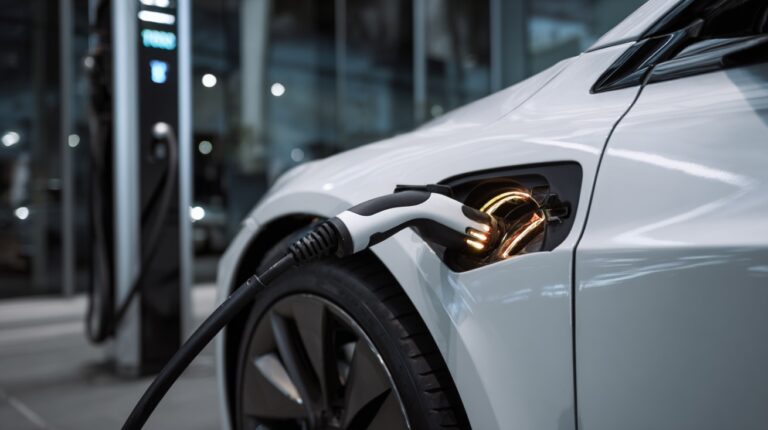
Many EV owners believe that you should always charge your EV to 100% to get the maximum range and peace of mind.
At first glance, that logic makes sense. A full battery seems like the safest option, especially if you want to avoid range anxiety.
Charging to 100% every time, however, is not always the best habit for long-term battery health. Occasional full charges are perfectly fine.
Making 100% your default daily target can increase battery stress and gradually reduce usable capacity over time.
Let us see all the reasons why this happens.
Why 100% Is Not Ideal for Everyday Charging?
Charging an electric vehicle to 100% every day is discouraged because it can speed up battery degradation, shortening its lifespan and reducing its ability to retain energy over time.
Many drivers assume that it is best to charge their EV to 100% every night to ensure maximum range the next morning. Battery chemistry and charging behavior tell a different story.
Increased Battery Stress and Degradation
A higher state of charge means higher voltage inside each cell. As voltage rises near 100%, internal chemical reactions become more aggressive. Over time, that added stress can contribute to faster capacity loss.
Charging to 100% places lithium-ion cells under greater strain than stopping at 80% or 90%. Repeating that pattern daily keeps the battery at peak voltage for longer periods, especially if the vehicle sits parked after reaching full charge.
- Elevated voltage increases side reactions inside the cell, which gradually reduce usable capacity.
- Holding a battery at 100% for extended periods can intensify chemical aging.
- Frequent full cycles add cumulative stress compared to partial cycles within a moderate range.
Battery degradation is inevitable in any lithium-ion pack. Still, frequent full charges can speed up that process. Many experts recommend setting a daily limit below 100% to help maintain usable range over the long term.
Temperature adds another layer of stress. High ambient heat during or after you charge your EV raises internal battery temperature and accelerates chemical reactions. Combining high heat with a full charge can significantly increase degradation risk.
Parking in direct sunlight right after reaching 100% can further compound the issue.
Charging Efficiency and Time Trade-Offs
Charging behavior also changes as the battery fills. Power delivery is strongest at low to mid SoC, then gradually tapers as the pack approaches full capacity.
Most EVs reduce charging speed after roughly 80% to protect battery health and control heat. As a result, the last 10% to 20% often requires a disproportionate amount of time.
- Rapid energy gain occurs between low charge levels and around 60% to 80%.
- Noticeable tapering after about 80% as the system limits current.
- Slow final stretch up to 100%, sometimes taking nearly as long as the earlier portion of the session.
Time spent waiting for that last segment often provides limited practical benefit for daily driving. For a typical commute, the additional range gained between 80% and 100% may not be necessary.
Stopping at 80 or 90% can reduce wait times and lower battery stress at the same time.
When Charging to 100% Makes Sense
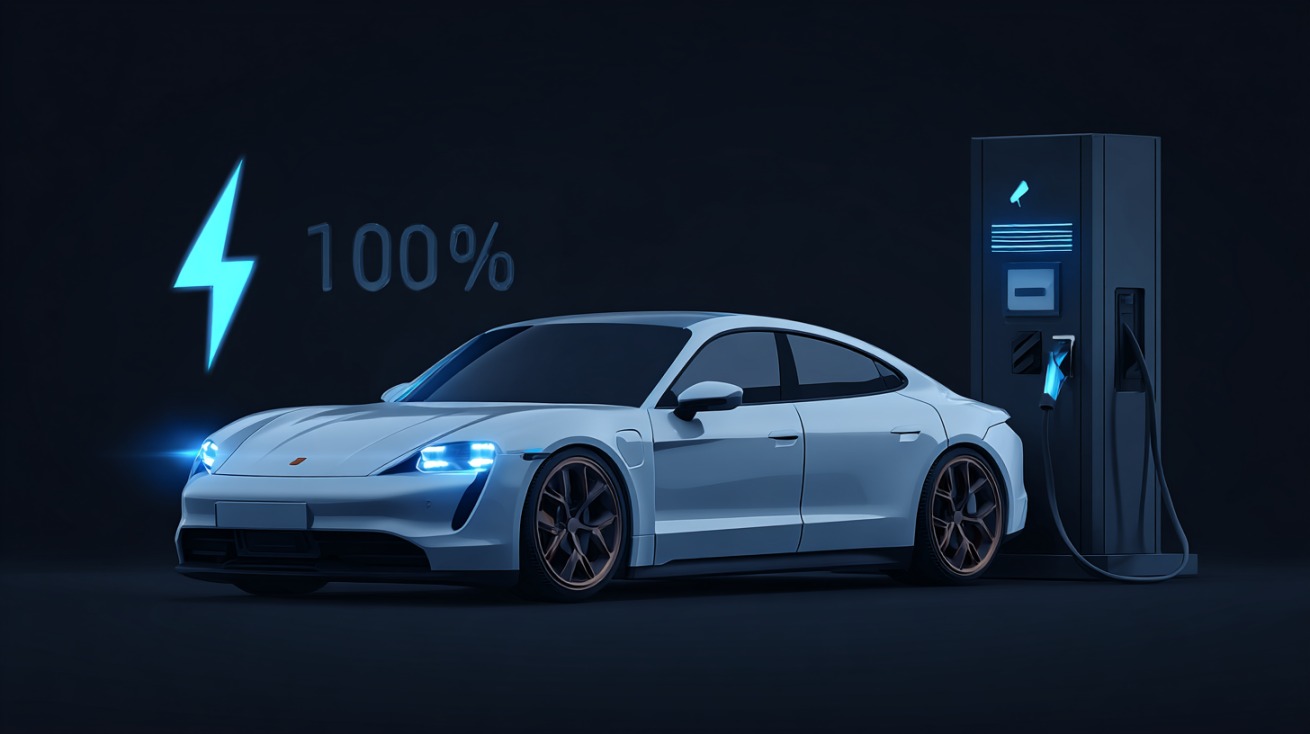
Avoiding 100% as a daily routine does not mean it should never be used. Certain scenarios justify a full charge and make it a smart decision.
Long Road Trips
Extended highway travel places higher energy demands on an EV. Starting a trip with a full battery can reduce the number of charging stops and provide added flexibility in route planning.
Long gaps between charging stations may require the maximum available range. In such cases, it makes practical sense to charge your EV to 100% shortly before departure.
- Maximizing the starting range to reach the first charging stop with a safe buffer.
- Reducing total trip time by minimizing extra charging sessions.
- Accounting for higher highway energy consumption compared to city driving.
Charging to full right before leaving, rather than hours earlier, can help limit the time the battery remains at high SoC.
Cold or Extreme Weather
Cold temperatures reduce battery efficiency and usable range. Chemical reactions slow down, and energy consumption rises due to cabin heating and battery conditioning.
Charging to 100% before driving in freezing conditions can help offset these effects. Extra range may provide reassurance and reduce the need for an additional stop.
Hot weather presents a different challenge. Heat combined with high SoC increases internal stress. In very warm climates, careful timing can reduce strain. Charging to full shortly before departure, instead of letting the car sit at 100% in high heat, is often a smarter approach.
Battery Management System Needs
Battery Management Systems track cell voltage, temperature, and overall pack health. Accurate range estimation depends on proper calibration and cell balancing.
- Allowing the BMS to recalibrate its estimate of total usable capacity.
- Helping equalize cell voltages across the pack.
- Improving the accuracy of the displayed range at both high and low SoC.
An occasional 100% session is usually sufficient for these purposes. Daily full charging is not required for proper calibration in most vehicles.
How EV Batteries Work
View this post on Instagram
Electric vehicles rely primarily on lithium-ion battery packs composed of many individual cells. Each cell operates within a defined voltage range. Performance and longevity depend heavily on how that range is used.
Higher voltage near full charge increases internal stress on electrodes and electrolytes. Lower voltage at very low SoC can also contribute to wear. Moderate charge levels tend to provide a more stable operating condition.
State of Charge represents the age of total battery capacity currently available. Industry guidance often points to a mid-range window, roughly 20% to 80%, as a favorable zone for daily use.
Keeping the SoC within that range when you charge your EV can reduce long-term degradation while still providing ample driving distance.
Partial cycles within a moderate band generally create less cumulative strain than frequent full cycles. Over years of ownership, that difference can translate into better retained capacity.
Battery Chemistry Matters
Not all EV batteries respond the same way to high SoC. Chemistry plays a major role in determining how often it makes sense to charge your EV to 100%.
LFP Batteries
Lithium Iron Phosphate batteries are known for strong thermal stability and tolerance to higher charge levels. Many newer EV models, including certain Tesla and BYD vehicles, use LFP packs.
LFP chemistry handles frequent full charges better than many other lithium-ion types. Some manufacturers recommend charging LFP batteries to 100% about once per week to maintain accurate range estimation.
- Greater tolerance for high SoC without equivalent degradation.
- Slightly lower energy density compared to NMC or NCA chemistries.
- Manufacturer guidance, in some cases supporting regular full charges for calibration.
Drivers with LFP packs can often charge their EV to full more frequently, especially if following official recommendations.
NMC and NCA Batteries
Nickel Manganese Cobalt and Nickel Cobalt Aluminum batteries offer higher energy density, which supports a longer range in a given pack size. Higher energy density comes with increased sensitivity to high voltage stress.
Holding NMC or NCA batteries near 100% regularly can accelerate capacity loss. For that reason, daily charge limits between 80% to 90% are often recommended.
- Reduce time spent at peak voltage.
- Lower cumulative chemical stress.
- Help preserve long-term usable capacity.
Exact recommendations vary by manufacturer and model. Owner manuals and official automaker guidance remain essential resources when deciding how to charge your EV for optimal battery health.
Summary
Charging to 100% every time is not necessary for typical daily driving. Making that level your routine target can increase battery stress and gradually reduce long-term capacity.
A balanced approach works best. Charge your EV to moderate levels for everyday use, and reserve 100% sessions for road trips, extreme weather, or occasional system calibration.
Thoughtful charging habits can help maintain battery health and usable range over many years of ownership.