
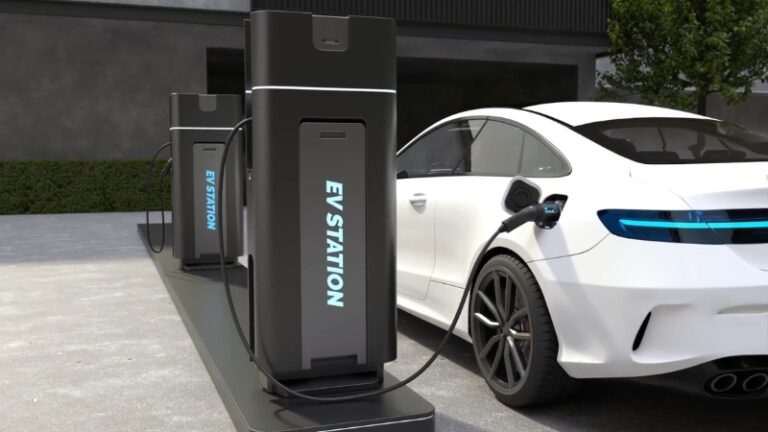
In 2026, installing a Level 2 home EV charging station in the United States typically costs between $3,000 and $9,000 fully installed, depending on electrical capacity, regional labor rates, distance from the service panel, permitting requirements, and whether a panel upgrade is required.
Commercial DC fast charging installations generally range from $70,000 to $200,000 per port installed, once transformer upgrades, demand charge considerations, and site work are included.
EV adoption continues to expand steadily. Data from the U.S. Department of Energy and the International Energy Agency indicate that U.S. EV sales surpassed 1.7 million units in 2025 and entered 2026, representing roughly 12 percent of new vehicle sales.
Battery capacities have also grown. Many mainstream EVs now ship with 70–100 kWh battery packs, which increases charging demand and infrastructure requirements at home.
More than 80 percent of EV charging still occurs at home. That single fact makes residential charging infrastructure the most important long-term cost consideration for EV owners.
The charger hardware itself is often the smallest part of the project. Electrical upgrades, permitting, wiring, and compliance requirements often represent the majority of the total cost.
EV Charging Levels in 2026: What They Actually Mean for Cost
Level 1 Charging (120V): Lowest Cost, Slowest Performance
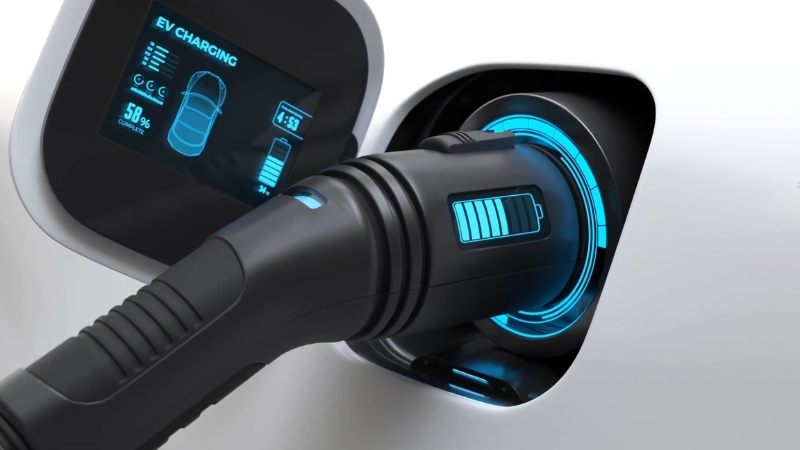
Level 1 charging uses a standard 120V outlet. Nearly every EV sold includes a portable Level 1 charging cable. Because it does not require special infrastructure, it has the lowest upfront cost.
However, the charging speed is limited. In 2026, most EVs gain approximately 3 to 5 miles of range per hour on Level 1. For a 75 kWh battery, full charging may require 24 to 36 hours.
Metric
Level 1 (2026)
Voltage
120V
Typical Output
1.3–1.9 kW
Hardware Cost
$0–$400
Installation Cost
$0–$500
Range Added per Hour
3–5 miles
Ideal Use Case
Short daily commutes
Level 1 charging remains viable for drivers traveling fewer than 30 miles per day. For larger daily mileage or multiple EV households, it becomes impractical.
Level 2 Charging (240V): Residential Standard in 2026
Level 2 charging remains the dominant home solution. It operates at 240V and typically delivers between 7.2 kW and 11.5 kW of power. Some higher-capacity residential installations now support up to 19.2 kW if the vehicle and panel allow.
Most homeowners install 40A or 48A chargers. These add roughly 20 to 45 miles of range per hour.
Metric
Level 2 (2026)
Voltage
240V
Typical Output
7.2–11.5 kW
Charger Hardware Cost
$500–$1,500
Fully Installed Cost
$3,000–$9,000
Typical Charge Time
4–8 hours
Most Common Use
Daily home charging
The upper range of $9,000 reflects installations requiring panel upgrades, trenching, or detached garage wiring.
Level 2 charging is considered essential for households driving more than 40–50 miles daily or for homes with two EVs.
DC Fast Charging (Level 3): Commercial Infrastructure
DC fast charging continues to expand nationwide. Networks such as Electrify America, EVgo, and ChargePoint now operate thousands of high-power charging ports.
Modern fast chargers typically range from 150 kW to 350 kW. Many new EVs can reach 80 percent charge in 18 to 30 minutes under optimal conditions.
Metric
DC Fast Charging (2026)
Power Output
150–350 kW
Equipment Cost
$40,000–$100,000
Fully Installed Cost
$70,000–$200,000+
Utility Infrastructure
Often requires a transformer upgrade
Primary Use
Highway and retail corridors
The largest cost drivers are electrical demand charges, transformer installation, trenching, permitting, and grid interconnection requirements.
Residential DC fast charging is almost never economically practical due to electrical service limitations.
What Actually Drives Home Installation Costs in 2026
The advertised charger price rarely reflects the total project cost. The electrical system determines feasibility and cost.
Electrical Panel Capacity and Upgrades
Many homes built before 2000 have 100-amp service panels. A 48A EV charger requires a 60-amp breaker under National Electrical Code continuous load rules. That often pushes homes beyond safe panel capacity.
Upgrade Type
Typical 2026 Cost
Panel Upgrade to 200A
$2,000–$5,000
Service Line Upgrade
$3,000–$8,000
Smart Load Management System
$600–$1,800
Load management systems are increasingly common in 2026. These devices allow EV charging to throttle automatically when other appliances are in use, avoiding a full panel replacement. This can save several thousand dollars.
Panel upgrades are the most significant variable in residential installation cost.
Wiring Distance and Labor
Copper prices remain elevated compared to pre-2020 averages. Longer conduit runs significantly increase the cost.
Installation Scenario
Estimated 2026 Cost
Simple Garage Install
$800–$1,800
25–50 ft Conduit Run
$1,800–$3,500
Detached Garage Trenching
$3,000–$7,000
Labor rates for licensed electricians now average $75–$150 per hour in many metro areas.
Permitting and Inspection
Most municipalities require permits and inspections for 240V installations. Permit costs range from $100 to $500, depending on location. Inspection delays can add time, but rarely significant cost unless corrections are required.
Public Charging Costs in 2026
View this post on Instagram
Public charging prices vary significantly by region and power level.
Charging Type
Typical Price in 2026
Public Level 2
$0.25–$0.45 per kWh
DC Fast Charging
$0.40–$0.75 per kWh
Idle Fees
$0.50–$2.00 per minute
In high electricity states such as California, fast charging during peak hours can approach gasoline cost equivalency.
EV vs Gasoline Operating Cost
Average gasoline prices in early 2026 range between $3.30 and $3.90 per gallon nationally. Residential electricity averages approximately $0.16–$0.19 per kWh.
Example comparison over 45,000 miles:
Vehicle Type
Estimated Energy Cost
Gasoline Vehicle
$5,000–$6,500
EV (Home Charging)
$2,400–$3,200
EV (Primarily Fast Charging)
$3,200–$4,500
Home charging provides the strongest economic advantage.
Federal Incentives in 2026
The federal Alternative Fuel Infrastructure Tax Credit continues to provide:
- 30 percent of the installation cost
- Up to $1,000 maximum for residential installations
Eligibility requirements may depend on census tract location and income thresholds.
Many utilities also provide rebates between $300 and $2,000 for installing smart chargers enrolled in time-of-use programs.
Charging overnight during off-peak hours can reduce cost to as low as $0.09–$0.12 per kWh in some regions.
Long-Term Ownership Economics
A typical residential EV charger lasts 10 to 15 years. Smart chargers now include WiFi connectivity, load management, remote monitoring, and scheduled charging features.
As battery sizes increase, charging frequency increases, but per-mile electricity cost remains lower than gasoline in most states.
Homes in EV-dense markets often see higher resale appeal when equipped with installed charging infrastructure.
Full 2026 Cost Example
Example mid-range suburban installation:
- 48A Level 2 charger: $850
- 40 ft conduit run: $1,800
- Permit and inspection: $250
- Labor: $1,500
- No panel upgrade required
- Total before credit: $4,400
- Federal credit: $1,000
- Net cost: $3,400
Example requiring panel upgrade:
- Charger: $900
- Panel upgrade: $3,500
- Wiring and labor: $2,500
- Permit: $300
- Total before credit: $7,200
- Federal credit: $1,000
- Net cost: $6,200
Bottom Line
Planning to get an EV charging system for your home?
Here’s how to ensure your charger is installed safely & properly: https://t.co/e0gDusSDxy pic.twitter.com/9s0Dgc5k0O
— Centre Wellington Hydro (@CWhydro) February 11, 2026
In 2026, a Level 2 home EV charging station typically costs $3,000 to $9,000 installed, with panel upgrades driving higher totals. DC fast charging installations for commercial use often exceed $100,000 per port once infrastructure is included.
Home charging remains significantly cheaper than public fast charging over long-term ownership.
Despite higher upfront installation costs compared to earlier years, improved incentives, smarter load management systems, and growing EV adoption continue to make residential charging the most practical and financially efficient solution for EV owners.