
Low-carbon cement is any cementitious binder engineered to deliver the same structural performance as conventional ordinary Portland cement while producing substantially lower lifecycle greenhouse gas emissions, primarily by reducing clinker content, altering raw materials, or changing the chemistry of hydration.
In practice, this means cutting the largest source of cement emissions, calcination of limestone and high-temperature kiln fuel, without compromising code compliance, durability, or constructability.
Why Cement Is a Climate Problem and Where Emissions Come From
View this post on Instagram
Global cement production exceeds 4 billion tonnes per year and accounts for roughly 7–8 percent of global CO₂ emissions, a figure consistently cited by the International Energy Agency.
About 60 percent of cement’s emissions arise from calcination, the chemical conversion of limestone (CaCO₃) to lime (CaO) that releases CO₂ regardless of fuel choice. The remaining ~40 percent comes from thermal energy required to heat kilns to around 1,450°C, historically supplied by coal or petcoke.
Because calcination is intrinsic to Portland clinker, deep decarbonization cannot rely on efficiency alone. Low-carbon cement addresses the problem at the chemistry and materials level by lowering clinker content, substituting industrial byproducts, or adopting alternative binders whose reactions do not release CO₂ in the same way.
What “Low Carbon” Means in Cement: Metrics and Boundaries
The term “low carbon cement” is meaningful only when tied to embodied carbon, the total CO₂-equivalent emissions associated with producing a tonne of cement or cubic meter of concrete, measured cradle-to-gate or cradle-to-site.
In current Environmental Product Declarations (EPDs), conventional CEM I/OPC typically ranges from 800–900 kg CO₂e per tonne of cement, while low carbon formulations can reach 300–600 kg CO₂e per tonne, and in some cases lower.
Two boundaries matter:
- Binder-level accounting (cement only): useful for comparing products at the mill.
- Concrete-level accounting (cement plus aggregates, transport, batching): decisive for project decisions.
The biggest reductions almost always come from reducing the clinker factor. Fuel switching and renewable electricity help, but they do not eliminate calcination emissions.
Main Types of Low-Carbon Cement and How They Work
1) Blended Cements (Lower Clinker Factor)
Blended cements replace a portion of Portland clinker with supplementary cementitious materials (SCMs). These materials react hydraulically or pozzolanically, forming strength-giving phases while avoiding calcination emissions.
Common SCMs include ground granulated blast furnace slag (GGBS), fly ash, natural pozzolans, calcined clays, and limestone. Standards bodies such as ASTM International and EN 197-5 now explicitly allow higher substitution levels than a decade ago.
| Blended Cement Type | Typical Clinker Content | CO₂ Reduction vs OPC | Notes on Performance |
| CEM II (Portland-limestone) | 65–80% | 10–20% | Early strength close to OPC |
| Slag cement (CEM III) | 30–60% | 30–50% | Excellent durability, slower early strength |
| Fly ash blends | 70–85% | 15–30% | Availability is declining in some regions |
| LC3 (limestone–calcined clay) | ~50% | 35–40% | Strong durability, emerging codes |
2) Alkali-Activated Materials and Geopolymer Cements
Alkali-activated cements use aluminosilicate-rich precursors (slag, fly ash, calcined clays) activated by alkaline solutions rather than Portland clinker hydration.
Because they avoid limestone calcination, embodied carbon can be 40–80 percent lower than OPC, depending on activator chemistry and sourcing.
Performance is not experimental. Compressive strengths of 40–80 MPa are routine, with excellent chemical resistance.
The barriers are standardization, handling of alkaline activators, and conservative code frameworks, rather than mechanical capability.
3) Calcium Sulfoaluminate (CSA) Cements
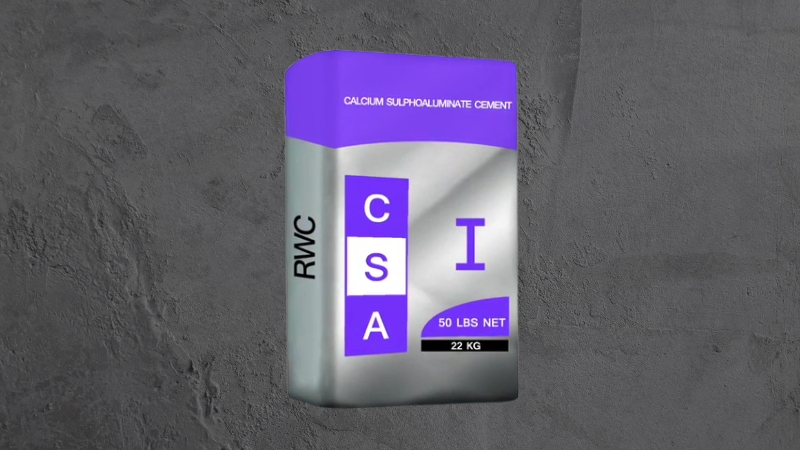
CSA cements use belite and ye’elimite phases that form at lower kiln temperatures (around 1,250°C) and require less limestone. CO₂ reductions of 20–40 percent are typical.
CSA cements offer rapid strength gain and controlled expansion, making them attractive for precast, repair mortars, and fast-track construction.
4) Carbon-Cured and Carbon-Mineralized Cements
Some systems inject captured CO₂ during curing, mineralizing it into stable carbonates within the concrete matrix. This does not eliminate calcination emissions but permanently stores a portion of CO₂ while improving early strength.
The net reduction varies widely (5–15 percent at the concrete level), but the approach is compatible with existing batching infrastructure.
Materials Behind Low-Carbon Cement: Availability and Constraints
The effectiveness of low-carbon cement is tied to materials supply. Slag availability depends on steelmaking routes, fly ash from coal-fired power generation, and calcined clays on suitable kaolinitic deposits.
| Material | Source | Long-Term Availability Outlook | Key Constraint |
| GGBS | Blast furnace slag | Stable in regions with steel | Regional supply imbalance |
| Fly ash | Coal power plants | Declining in many countries | Quality variability |
| Calcined clay | Natural clay | High, globally | Calcination infrastructure |
| Limestone filler | Quarries | Very high | Limited substitution percentage |
This reality explains why there is no single universal low-carbon cement. Regional strategies dominate, and blended solutions tailored to local supply chains are the norm.
Embodied Carbon Reduction in Practice: Quantified Impacts
When evaluated at the concrete mix level, clinker reduction dominates all other levers. A typical structural concrete using OPC at 320 kg cement/m³ might carry 300–350 kg CO₂e/m³.
Switching to a high-slag or LC3 binder can reduce this to 180–220 kg CO₂e/m³ without changing structural design.
| Strategy | Typical CO₂ Reduction at Concrete Level |
| Reduce cement content via mix optimization | 5–15% |
| Switch OPC to CEM II | 10–20% |
| Use high-slag or LC3 binder | 30–40% |
| Carbon curing/mineralization | 5–15% |
Strength, Durability, and Structural Performance
A persistent misconception is that low-carbon cement means weaker concrete. In reality, 28-day compressive strength targets are routinely met, and long-term strength often exceeds OPC due to denser microstructures.
Slag and calcined clay systems improve sulfate resistance, reduce chloride ingress, and lower the heat of hydration, directly extending service life in marine and infrastructure applications.
The trade-off is often early-age strength, which can be managed through curing regimes, admixture selection, or partial clinker retention. Structural engineers working with performance-based specifications rather than prescriptive cement types already account for these variables.
Cost and Market Reality
At the cement level, low carbon products can range from cost-neutral to 10–25 percent higher than OPC, depending on SCM pricing and logistics.
At the project level, the impact is usually smaller because cement is a fraction of the total construction cost.
| Cost Component | Effect of Low-Carbon Cement |
| Material price | Slightly higher or neutral |
| Concrete mix cost | +0–10% typical |
| Structural cost | Often unchanged |
| Lifecycle cost | Often lower due to durability |
Public procurement policies in Europe and parts of North America increasingly require EPD-based comparisons rather than the lowest first cost, shifting market dynamics.
Codes, Standards, and Adoption Barriers
Technical standards have evolved faster than perception. New cement definitions under EN 197-5 and performance-based pathways recognized by organizations like the Portland Cement Association allow broader adoption than many practitioners realize.
The main barriers are not engineering limits but conservative specifications, fragmented approval processes, and a lack of familiarity among contractors. Where performance specifications are used, adoption rates rise sharply.
Use Cases Where Low-Carbon Cement Already Makes Sense
Low-carbon cement is not confined to pilot projects. It is already deployed at scale in foundations, slabs, precast elements, marine structures, and transportation infrastructure, where durability matters more than ultra-fast early strength.
Precast manufacturers in particular benefit from controlled curing that offsets slower hydration.
The Bottom Line
@xprize Concrete is one of the largest contributors to CO2 emissions. CarbonBuilt, one of the two grand prize winners of the NRG COSIA Carbon XPRIZE, is working to transform the concrete industry through its groundbreaking technology. The company’s tech reduces the carbon footprint of concrete by more than 50%, while reducing costs and increasing profitability. CarbonBuilt aims to scale across the U.S. and globally, making ultra-low carbon concrete the new industry standard. Solving climate change won’t come from one sector alone. It’ll take collaboration across many different industries, and CarbonBuilt’s impactful work is truly leading the charge. Learn more about CarbonBuilt in this episode of XPRIZE Innovators at youtube.com/xprize. #fyp #technology #climatechange ♬ Ride At Dawn – Above & Beyond & Zoë Johnston
Low-carbon cement is not a single product but a family of technically mature solutions that cut embodied carbon primarily by reducing clinker.
Blended cements, alkali-activated systems, CSA binders, and carbon-mineralized concretes already meet structural requirements, comply with evolving standards, and deliver meaningful emissions reductions today.
The limiting factors are specification culture and supply chain alignment, not material science.