
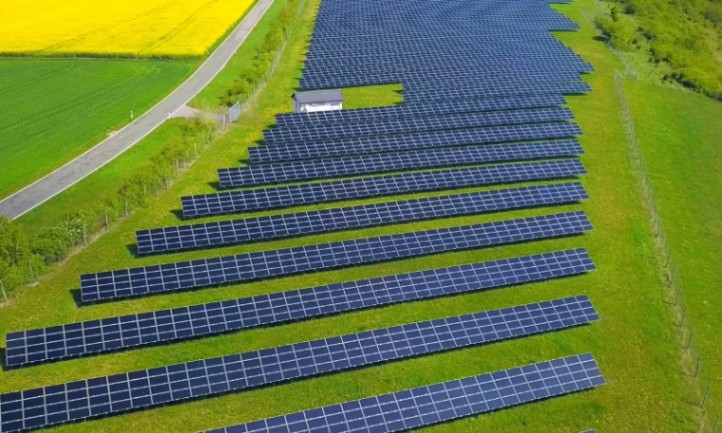
Solar energy can be integrated into active farmland without removing land from agricultural production through agrivoltaics, a system that places photovoltaic panels above or between crops so that food and electricity are produced on the same land.
When designed correctly, agrivoltaic systems can maintain or improve yields for specific crops, reduce water stress, generate stable farm income, and improve land productivity per hectare compared with single-use farming or solar development alone.
What Agrivoltaics Actually Means in Practice
Agrivoltaics refers to the intentional co-location of solar photovoltaic infrastructure and agricultural production. The concept was first formalized in Japan in the early 2000s, with government guidance published in 2013 that allowed solar installations on farmland provided crop production continued. Since then, large-scale research programs have emerged in Europe, the United States, China, and Australia. The key distinction between agrivoltaics and conventional solar farms is that crop growth, grazing, or horticulture is a primary design constraint, not an afterthought.
In practical terms, this means higher mounting structures, wider row spacing, altered panel tilt angles, or tracking systems that respond not only to sunlight but also to crop requirements. The goal is not to maximize electricity output per square meter of panel area, but to maximize combined agricultural yield and energy output per hectare of land.
Why Agriculture Is a Logical Place for Solar Deployment
Agriculture uses more land than any other human activity. In the European Union, over 40 percent of the total land area is agricultural. In the United States, farmland covers roughly 370 million hectares. At the same time, farmers face volatile commodity prices, rising energy costs, water scarcity, and increasing climate variability. Agrivoltaics directly intersects with these pressures.
From a land use perspective, dual-use systems address conflicts between food security and renewable energy expansion. From an economic perspective, they diversify farm revenue with long-term energy contracts or self-consumption.
Crop Yield Effects Under Agrivoltaic Systems
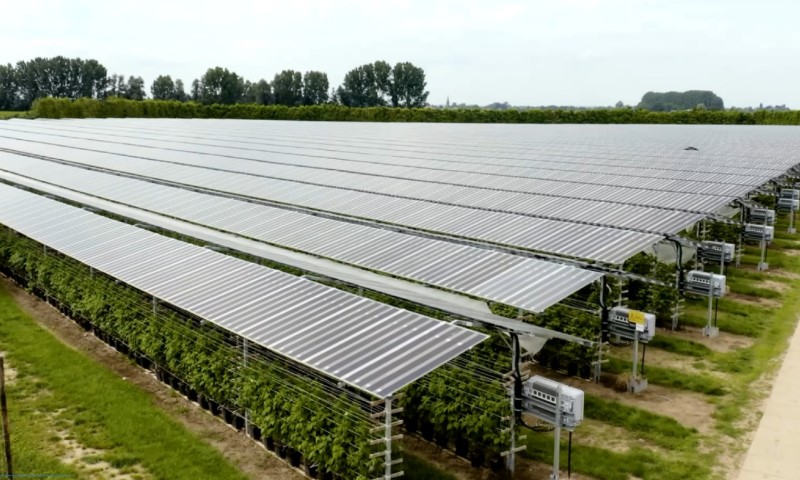
Crop response to partial shading is not uniform. Yield outcomes depend on crop physiology, local climate, panel density, height, and light distribution patterns. Extensive field trials now provide measurable data rather than theory.
Yield Outcomes Observed in Research Trials
Studies conducted by the Fraunhofer Institute in Germany between 2017 and 2022 showed that land equivalent ratios for agrivoltaic wheat, potato, and celery systems ranged from 1.2 to 1.7. This means that the combined food and energy output from one hectare exceeded what would normally require 1.2 to 1.7 hectares if produced separately.
In arid and semi-arid regions, shading effects are often beneficial. A University of Arizona trial found that cherry tomato yields under agrivoltaic panels increased by approximately 65 percent during extreme heat periods due to reduced heat stress and improved soil moisture. Conversely, light-sensitive cereals in low-latitude high-cloud-cover regions may experience yield reductions if panel density is excessive.
Observed Crop Yield Changes Under Agrivoltaic Conditions
| Crop Type | Climate Context | Yield Change Range | Primary Mechanism |
| Lettuce | Hot, arid | +20 to +40 percent | Reduced heat stress |
| Tomatoes | Semi arid | +10 to +65 percent | Lower evapotranspiration |
| Wheat | Temperate | -5 to +10 percent | Light interception balance |
| Potatoes | Temperate | +5 to +15 percent | Soil temperature moderation |
| Pasture grass | Mixed | Neutral to +20 percent | Improved moisture retention |
Water Use and Microclimate Effects
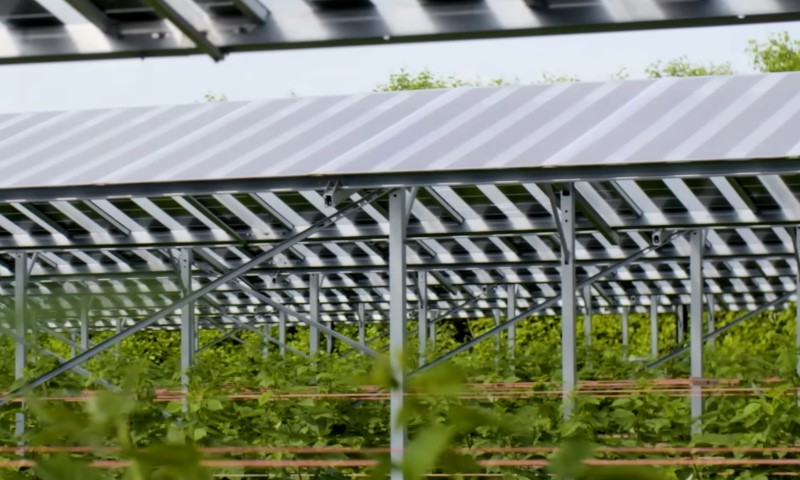
One of the most consistent benefits of agrivoltaics is water efficiency. Partial shading reduces direct solar radiation on soil, lowering surface temperatures and evaporation rates. Field measurements in France and southern Spain show soil moisture retention improvements of 10 to 30 percent under panel rows compared with open field controls.
The microclimate created under elevated panels also reduces wind speed at the crop level, further limiting moisture loss. In regions facing irrigation restrictions or declining groundwater reserves, this effect alone can justify agrivoltaic investment even if yields remain flat.
Livestock and Grazing Applications
Agrivoltaics is not limited to crop farming. Grazing under solar installations is one of the fastest-growing applications, particularly in sheep and poultry systems. Elevated or widely spaced panels provide shade that reduces heat stress, while animals help manage vegetation growth, reducing mowing and maintenance costs.
In the United States, several utility-scale solar farms now integrate managed sheep grazing, reporting reduced vegetation management costs of 20 to 40 percent.
Agrivoltaic Farm Design Options
Design choices determine whether agrivoltaics succeeds or fails. Poorly designed systems can suppress yields and restrict machinery access, while well-designed systems integrate seamlessly into farm operations.
Fixed Tilt Elevated Systems
These systems use stationary panels mounted at heights between 3 and 5 meters, allowing tractors and harvesters to pass underneath. They are structurally simpler and cheaper than tracking systems but require careful spacing to avoid excessive shading.
Single Axis Tracking Systems
Tracking systems rotate panels east to west, optimizing light capture while dynamically altering shade patterns. Advanced systems can be programmed to reduce shading during sensitive crop growth stages. These systems are more expensive but offer higher energy yields and greater agronomic flexibility.
Vertical Bifacial Panels
Vertical panels mounted in north-south orientation allow sunlight to pass between rows while capturing reflected light on both sides. This configuration is particularly compatible with grazing and certain row crops. Energy yields per panel are lower, but land accessibility is high.
Comparison of Agrivoltaic System Designs
| Design Type | Typical Height | Crop Compatibility | Energy Yield | Capital Cost |
| Elevated fixed tilt | 3–5 m | High | Medium | Medium |
| Single-axis tracking | 4–6 m | Very high | High | High |
| Vertical bifacial | 2–3 m | Moderate | Low–Medium | Low–Medium |
Economic Considerations and Cost Structure
View this post on Instagram
Agrivoltaic systems cost more than ground-mounted solar due to additional steel, foundations, and engineering. As of 2024, capital costs in Europe and North America typically range from 1.2 to 2.0 million USD per installed megawatt, compared with 0.8 to 1.1 million USD for conventional solar farms.
However, this comparison ignores agricultural revenue retention and water savings. When farm income is included, internal rate of return calculations often favor agrivoltaics, particularly on high-value crops or irrigated land.
Operating costs are usually lower than expected because vegetation management, cooling benefits, and distributed shading reduce maintenance stress on panels.
Simplified Cost and Revenue Comparison Per Hectare
| Land Use Model | Energy Revenue | Crop Revenue | Total Land Output |
| Crops only | 0 | 100 percent | 100 |
| Solar only | 100 percent | 0 | 100 |
| Agrivoltaics | 70–90 percent | 70–100 percent | 140–180 |
Grants, Incentives, and Policy Support
Public policy increasingly recognizes agrivoltaics as a land-efficient renewable strategy. Several countries now offer targeted incentives.
In the European Union, agrivoltaic projects may qualify under Common Agricultural Policy eco schemes and national renewable energy tenders. France introduced a formal agrivoltaic regulatory framework in 2023, defining minimum agricultural productivity thresholds.
In the United States, agrivoltaics can access USDA Rural Energy for America Program grants, state renewable energy credits, and research funding through the Department of Energy. Some states offer property tax relief for dual-use land.
Japan maintains a permit system requiring annual proof of continued agricultural output beneath solar arrays, reinforcing the food first principle.
Best Practices Based on Field Experience
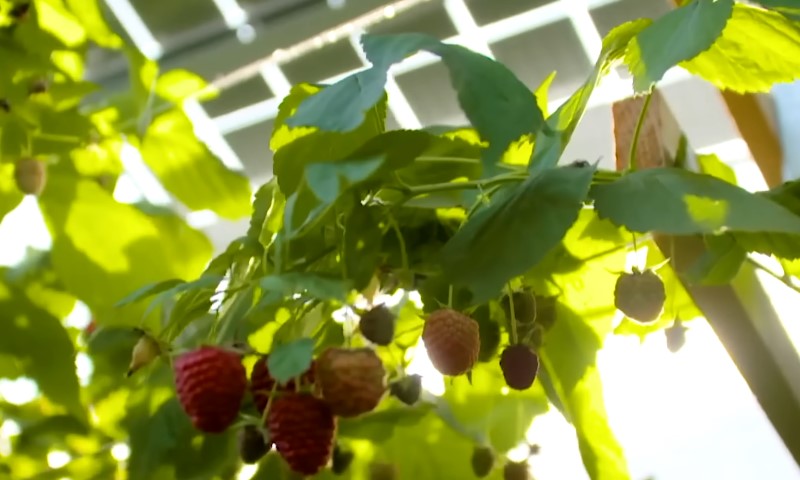
Successful agrivoltaic projects share several characteristics. Crops are selected based on shade tolerance rather than forcing existing rotations to adapt. Panel spacing and height are designed around actual farm machinery dimensions. Monitoring systems track both energy output and crop performance, allowing adaptive management.
Importantly, farmers who are directly involved in system design report higher satisfaction and better outcomes than projects imposed by external developers. Agrivoltaics works best as an integrated farm system, not a bolt-on energy project.
Long-Term Outlook for Agrivoltaics
As climate variability increases and land competition intensifies, agrivoltaics is likely to move from niche to mainstream in specific agricultural regions. The strongest adoption signals are currently in specialty crops, irrigated systems, and livestock operations, where shading benefits and revenue diversification are most tangible.
The central conclusion from existing data is clear. Agrivoltaics does not replace agriculture with solar. When designed properly, it increases the total productivity, resilience, and economic stability of farmland without sacrificing food production.