
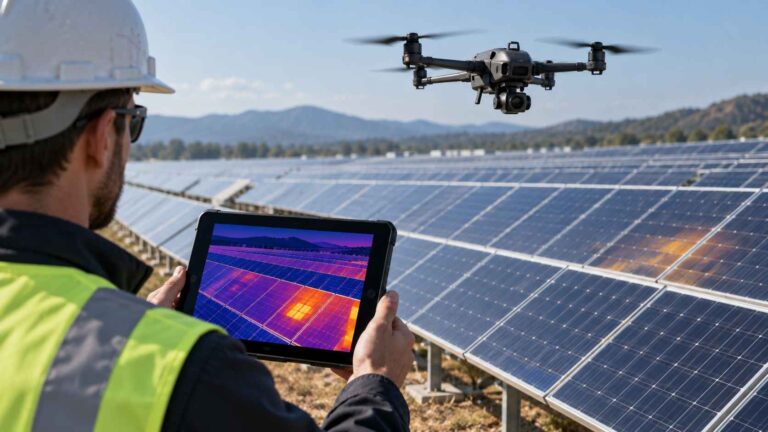
Finding one failing module inside a large solar array is not always easy from the ground. A panel can look normal and still contain a hot cell, damaged connection, failed bypass diode, or another electrical problem that reduces output.
Thermal drone inspections give maintenance teams a faster way to narrow the search. A drone fitted with an infrared camera flies above an operating photovoltaic system and records differences in surface temperature. Abnormal heat patterns point inspectors toward modules, strings, connectors, or sections of the array that deserve closer attention.
The technology is especially useful on commercial rooftops and large ground-mounted plants where checking panels one by one would take considerable time. It does not replace electrical testing or a physical inspection. Its main strength is finding suspicious areas quickly so technicians know where to concentrate their work.
Why Drones Fit Into Solar Panel Maintenance
Solar panels have no large moving assemblies, but long-term operation still exposes a system to heat, moisture, dirt, vegetation, electrical faults, damaged cells, loose connections, and weather events.
The U.S. Department of Energy includes thermal and infrared imaging among the methods used to identify hidden damage during photovoltaic operation and maintenance. Our guide to protecting and prolonging solar panel lifespan also covers the role of inspections, cleaning, monitoring, and electrical maintenance over the life of a system.
A drone changes how quickly technicians can inspect the physical array. Instead of walking row after row and checking modules individually, the aircraft follows a planned route while recording thermal images from above.
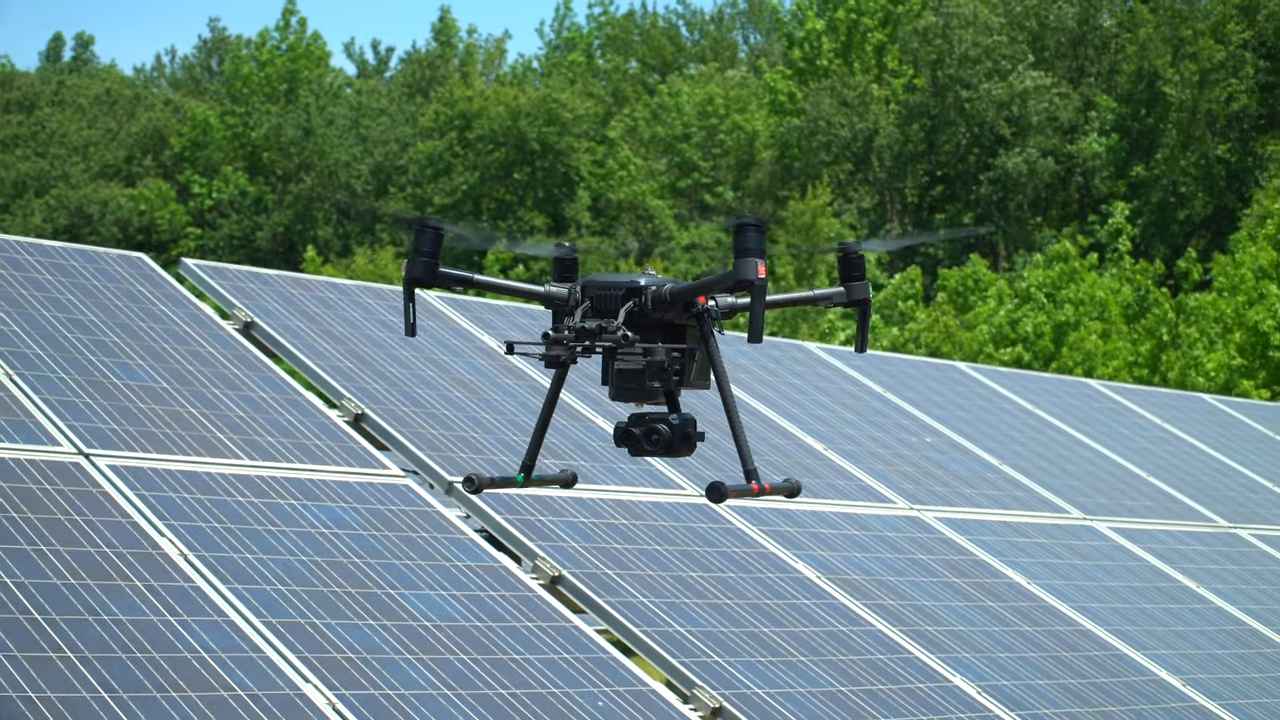
- Large areas can be screened in a relatively short period.
- Technicians spend less time searching manually for the source of an output problem.
- Thermal images create a record that can be compared with later inspections.
- Suspect modules can be mapped to their physical location.
- Roof access and work around large arrays can be reduced during the initial screening stage.
IEA PVPS notes that infrared imaging can detect problems ranging from hot spots and mismatch losses to installation failures, and that drone-based inspections allow large photovoltaic sites to be scanned during normal operation.
Important: A hot area in a thermal image is a finding, not a complete diagnosis. Dirt, shadow, a damaged cell, an electrical connection, or another condition can produce a similar thermal pattern. The next step is confirmation.
Teaching People to Use Drones for Solar Inspections
Buying a thermal drone is only the beginning. Operators need to learn flight control, mission planning, thermal imaging, photovoltaic layout, data handling, and the limits of what an infrared image actually proves.
Video Tutorials Are an Excellent First Step
Video tutorials are an excellent first step because operators can see the complete inspection process instead of reading isolated instructions. A useful training video can show how the aircraft approaches an array, how high it flies, how the camera stays aligned with the modules, what a clean thermal image looks like, and how an abnormal pattern appears on screen.
Companies building their own training material can record demonstration flights and turn the footage into short lessons for new operators. Tools such as a ChatGPT video editor can help organize recorded clips, prepare a rough sequence, add captions, and turn longer demonstrations into shorter training videos that focus on one task at a time.
- Pre-flight equipment checks
- Setting thermal camera parameters
- Choosing a safe flight path
- Maintaining consistent speed and altitude
- Recognizing glare and reflections
- Comparing thermal and visible-light images
- Marking the location of a suspect module
- Exporting images for a maintenance report
Video training should still lead into supervised field practice. A new operator needs experience with changing sunlight, wind, reflections, module layouts, and real thermal anomalies before taking responsibility for a full inspection.
How a Thermal Drone Inspection Actually Works
Infrared cameras do not see electrical current moving through a solar panel. They detect infrared radiation emitted from surfaces and translate those measurements into a thermal image.
Under normal operating conditions, modules exposed to similar sunlight and carrying similar electrical loads should produce reasonably consistent thermal patterns. An abnormal area that is significantly warmer or colder than surrounding modules becomes a point for investigation.
The Array Must Be Operating
Thermal inspection works best when the photovoltaic system is generating power under stable sunlight. Electrical defects create useful temperature differences when current is flowing through the system.
The current IEC TS 62446-3 specification for outdoor photovoltaic thermography covers inspection equipment, environmental conditions, procedures, reporting, personnel qualification, and the evaluation of thermal abnormalities.
For photovoltaic module inspection, the specification uses a minimum irradiance of 600 W/m² in the plane of the modules. Low irradiance can make temperature differences harder to distinguish.
The Drone Follows a Planned Route
Operators normally plan the flight before takeoff. The route should cover the complete array without leaving gaps and should maintain enough image detail to identify individual modules and smaller problem areas.
- Altitude
- Speed
- Camera angle
- Image overlap
- Coverage
The IEC guidance uses a maximum geometric resolution of 3 cm of module edge per pixel for module inspection. Flying too high with an inadequate camera can hide smaller thermal anomalies inside a few pixels.
Thermal and Visible Images Work Better Together
A thermal image might show a bright hot area, but it cannot always explain why the area is hot.
A normal RGB photograph taken at the same location helps the inspector check for dirt, bird droppings, vegetation, physical damage, shadows, or another visible explanation.
Pairing both image types also makes maintenance reports easier to use. A technician can see the thermal abnormality and the exact physical module that needs attention.
What Thermal Images Can Reveal
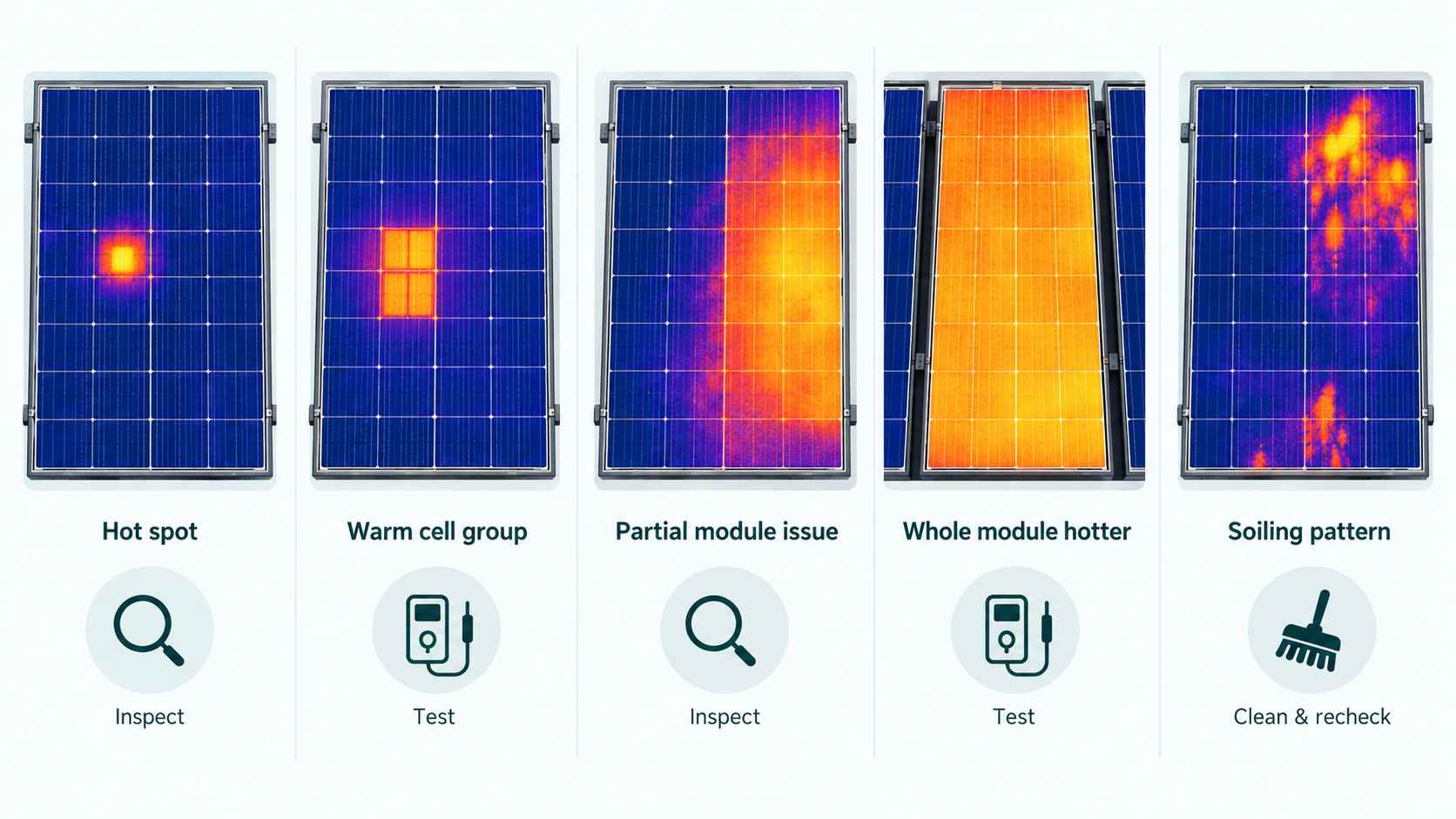
Different problems can produce different heat patterns. Experienced inspectors look at the size, shape, temperature difference, and position of each anomaly instead of treating every bright spot as the same fault.
| Thermal Pattern | Possible Explanation | Useful Follow-Up |
| One small hot area within a cell or module | Cell damage, local shading, soiling, electrical defect | Visual inspection and electrical testing |
| One complete cell or group of cells is warmer | Cell mismatch, cracked cell, bypass-related issue | Module testing and closer inspection |
| A large section of one module looks different | Substring or bypass diode problem | Electrical diagnosis at module level |
| An entire module is hotter than neighboring modules | Electrical mismatch, disconnected condition, module fault | Compare operating data and test the module |
| A complete string shows an unusual pattern | String-level electrical issue or disconnected circuit | Check string current, wiring, fuses, and connections |
| Irregular hot patches following visible dirt | Soiling or bird droppings | Clean and inspect again |
IEA PVPS research identifies aerial infrared thermography as a useful tool for detecting hot spots, disconnected strings, disconnected substrings, and other photovoltaic faults.
Hot Spots Need Context Before Anyone Replaces a Panel
A bright thermal spot does not automatically mean the panel belongs in the waste pile.
Hot spots can result from damaged cells, poor connections, shading, dirt, cracked glass, manufacturing defects, or current mismatch. IEA PVPS also notes that localized dirt and vegetation can create thermal behavior similar to electrical defects.
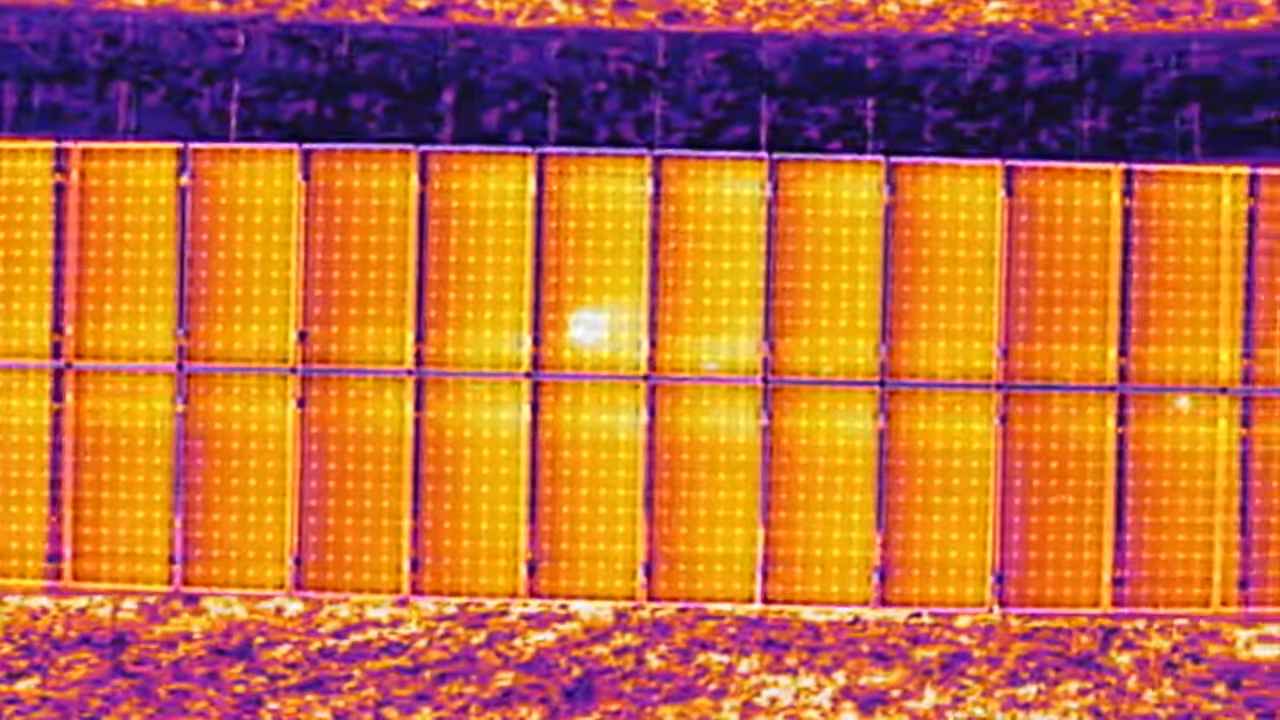
- The drone identifies an abnormal thermal pattern.
- The operator records its exact location.
- A visible-light image checks for dirt, damage, and shading.
- Technicians compare the finding with monitoring data.
- Electrical testing confirms the suspected fault.
- The maintenance team decides whether cleaning, repair, rewiring, or module replacement is required.
Replacing panels directly from drone images risks wasting functional equipment.
Weather Conditions Can Make a Good Inspection Useless
Thermal inspections depend heavily on environmental conditions. Flying on the wrong day can produce attractive images with poor diagnostic value.
Sunlight Needs to Be Strong and Stable
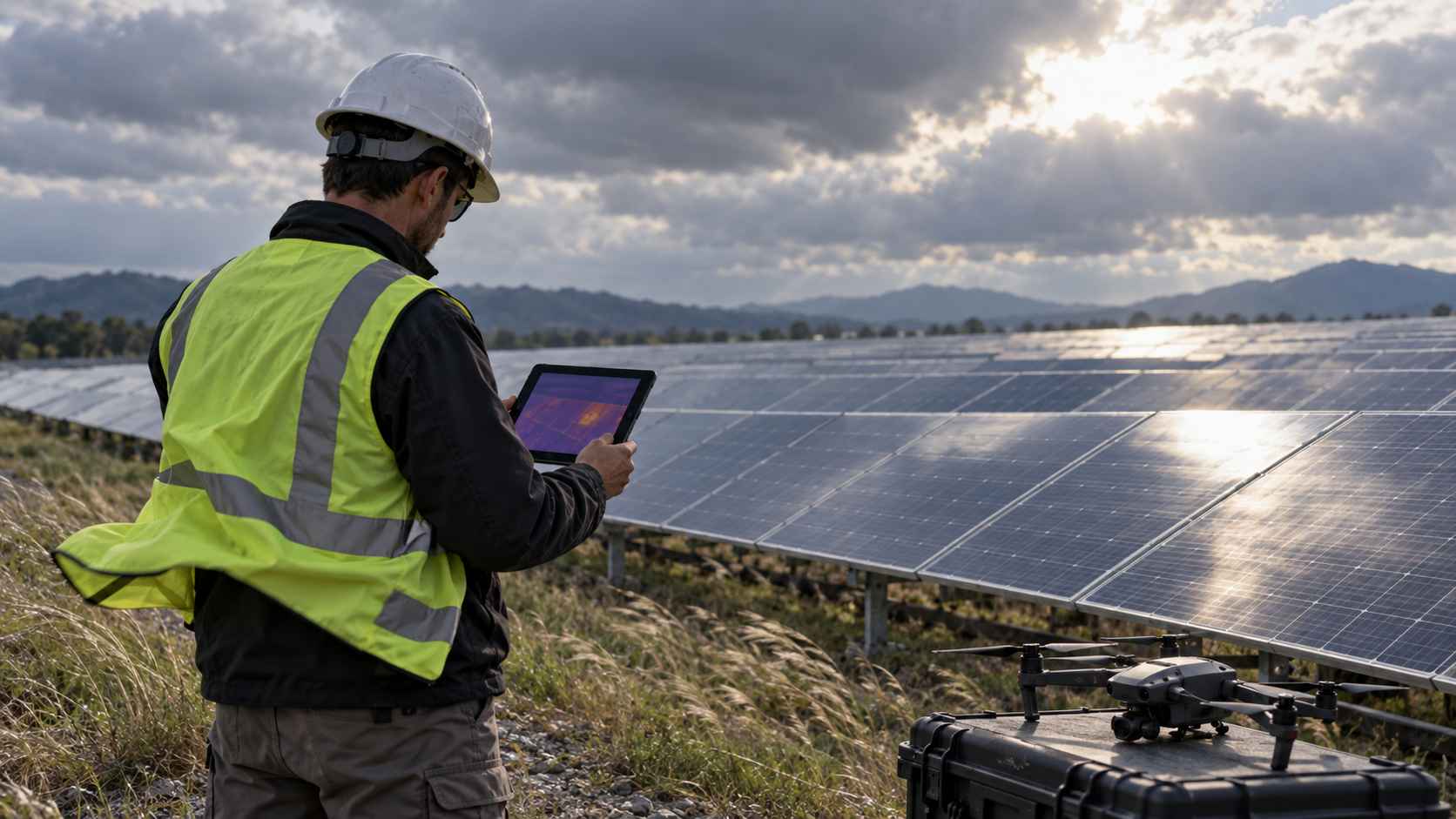
Strong sunlight creates electrical load and useful temperature differences. Rapid cloud movement changes irradiance across the array and can make one section appear different simply because the sunlight changed between images.
IEC TS 62446-3 recommends stable operating conditions and limits cumulus cloud coverage for standardized inspections.
Wind Cools the Panels
Wind removes heat from module surfaces. Strong or inconsistent wind can reduce temperature differences and make comparisons less reliable.
The IEC conditions set a maximum wind speed of Beaufort force 4, equivalent to about 28 km/h.
Reflections Can Look Like Heat
Solar module glass reflects parts of the surrounding environment. The sky, clouds, the sun, nearby structures, and even the drone can affect an infrared image.
Camera angle therefore plays a major role. An apparent hot region that moves or disappears when the viewing angle changes deserves scrutiny before it is classified as a module fault.
Soiling Creates One of the Most Common False Leads
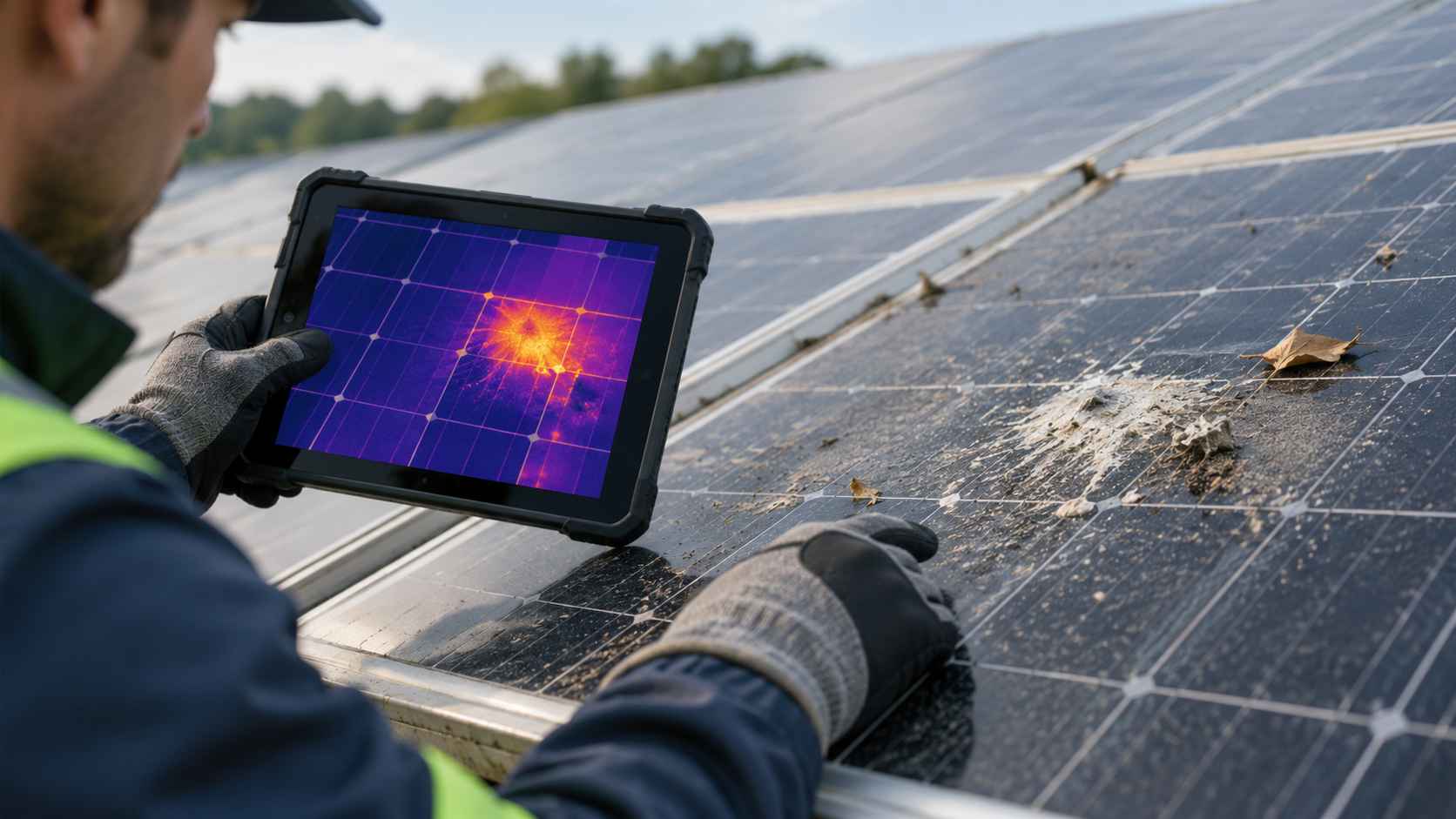
Dirt deserves special attention because it can affect both electrical output and thermal appearance.
Bird droppings, leaves, dust patches, and other localized obstructions can shade a small portion of a module. The shaded cell can then heat differently from surrounding cells.
A thermal camera detects the result, but the image alone does not tell the operator that dirt caused it.
Visible images become particularly valuable here. A quick comparison between the infrared and normal photograph can prevent a maintenance team from treating a cleaning issue as a failed module.
IEC guidance calls for no or low soiling during standardized thermal inspection and specifically recommends cleaning problematic contamination such as bird droppings when appropriate.
Drones Are Especially Useful on Large Solar Sites
The larger the array, the stronger the case for aerial inspection.
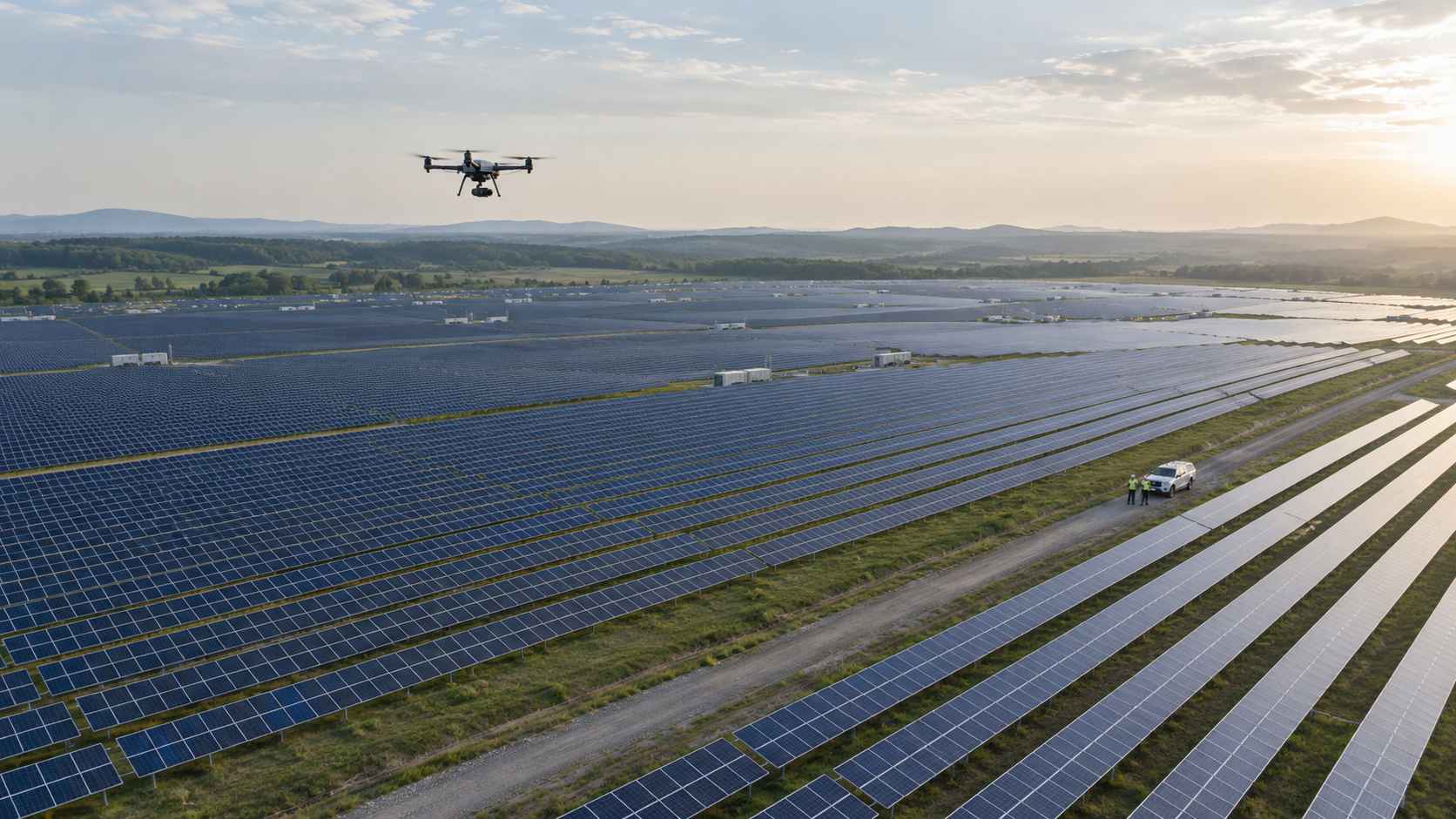
Walking through a utility-scale site and finding one problematic panel among tens of thousands is slow. A drone can collect a complete set of images first, allowing the maintenance team to work from a list of mapped anomalies.
IEA PVPS has reported that, under suitable conditions, infrared inspection of a 4 MW photovoltaic plant can take roughly five to ten hours using aerial methods.
Large industrial installations already require structured inspection, monitoring, vegetation control, electrical checks, and repair planning. Our guide to large industrial solar array installations explains how maintenance fits into the wider life cycle of a commercial system.
What Equipment Does a Useful Inspection Require?
A basic consumer drone with a normal camera is useful for visual roof checks, but it cannot perform a true thermal inspection.
- A stable drone platform
- A radiometric thermal camera
- A visible-light camera
- Accurate location data
- Mission-planning software
- Thermal analysis and reporting software
Radiometric cameras are especially useful because they retain temperature information for image pixels rather than producing only a colored picture.
Resolution Determines What the Operator Can See
Thermal resolution has a direct effect on inspection detail. A low-resolution sensor flown high above the array might identify a complete hot module but miss a smaller cell-level problem.
IEC TS 62446-3 specifies thermal sensitivity, measurement accuracy, spectral response, geometric resolution, and other camera requirements for standardized photovoltaic inspection.
Camera specifications therefore need to be considered alongside flight altitude. More altitude covers more ground per image, but each module occupies fewer pixels.
The Best Inspection Report Tells the Maintenance Team What to Do Next
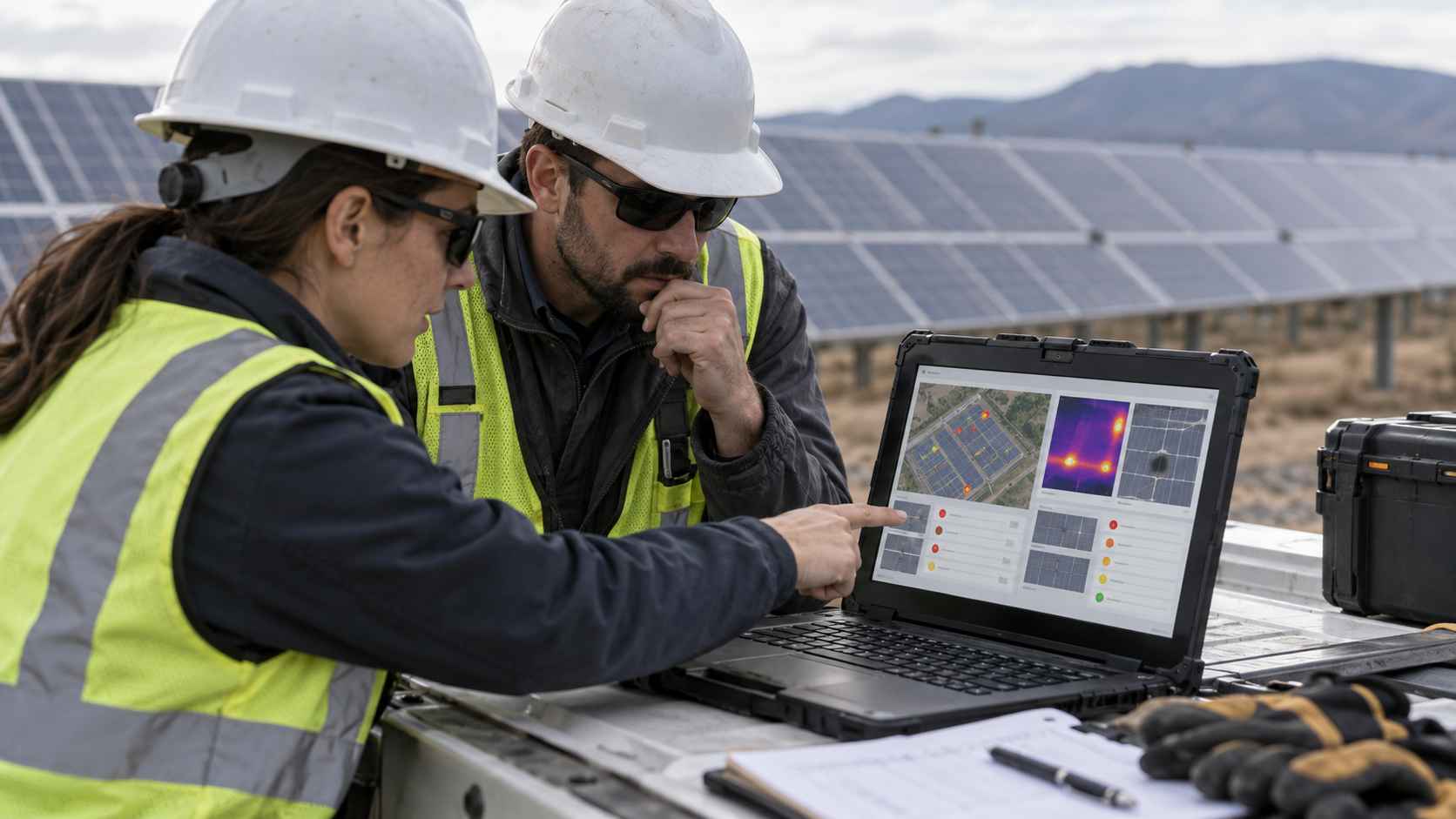
Hundreds of thermal images are not a useful maintenance report on their own.
A strong report organizes findings so technicians can move directly from the data to the physical equipment.
- Plant and inspection date
- Weather and irradiance conditions
- Drone and camera specifications
- Flight altitude and inspection method
- Location of each anomaly
- Thermal image
- Matching visual image
- Measured temperature difference where appropriate
- Initial fault classification
- Recommended follow-up test
- Repair status after inspection
Repeated inspections become more useful when the same identification system is used every time. A module flagged in June can be compared with the same module six months later instead of disappearing inside a folder of unrelated thermal images.
Thermal Drones Find Problems, Technicians Still Confirm Them
Drone thermography works best as part of a larger solar maintenance process.
The aircraft handles the fast screening stage. Thermal images reveal unusual areas. Visible photographs add physical context. Monitoring data shows whether production has changed. Electrical testing then confirms the cause before technicians repair or replace equipment.
The U.S. Department of Energy recommends regular photovoltaic operation and maintenance to manage issues including soiling, micro-cracking, corrosion, and other performance risks. Aerial infrared inspection adds a faster way to locate the sections that deserve direct attention.
For a small residential array, a drone inspection may only be useful after unexplained production loss, storm damage, or a suspected module problem. For a commercial rooftop or utility-scale plant, repeatable thermal flights can become part of preventive maintenance and post-storm assessment.
The main benefit is not simply putting a camera in the air. A well-run inspection turns thousands of panels into a manageable list of specific locations that technicians can investigate, test, and repair.